
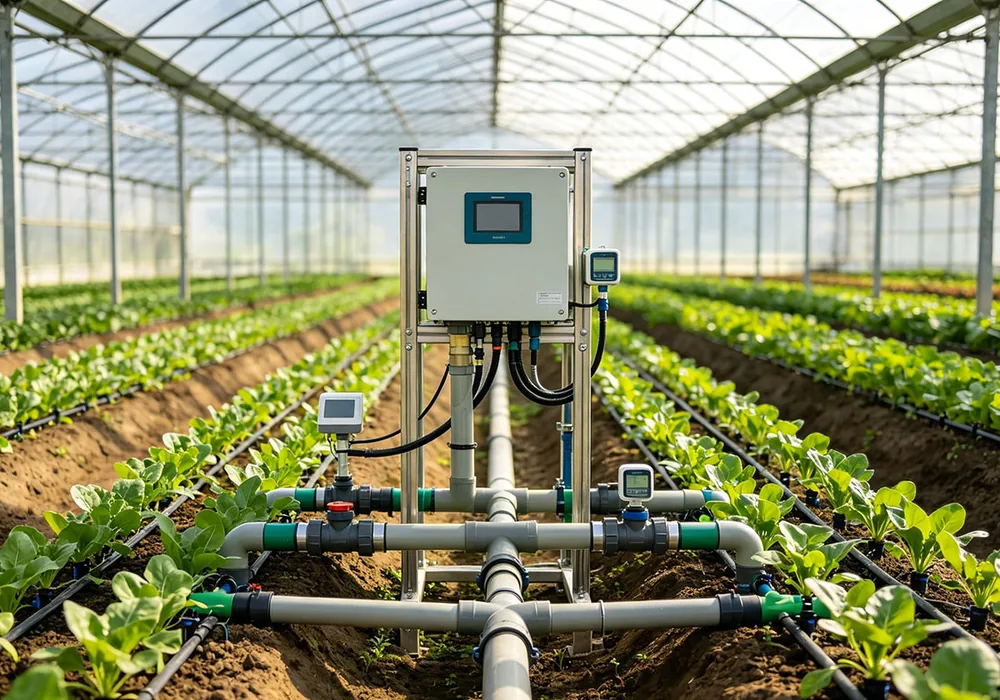
A fertigation machine works in one of the hardest environments on a farm: wet, warm and permanently exposed to fertilizer salts. Residue builds up in lines, screens and valves; probes collect film; terminals sit in damp air. Failures are rarely sudden. Most begin as a small loss of accuracy or a slow restriction and only become visible when the crop shows it. A short, regular routine is the cheapest reliability program available.
Cleaning is the main maintenance task
After each job, flush the whole circuit — machine, injector, filters and the lines downstream — with clean water until the residue is gone. Weekly, take out and clean the primary and secondary filter screens; sediment that stays in the screens raises pressure loss and eventually reaches the emitters. Monthly, wipe the control panel and the sensor probes. A clean probe gives a stable reading; a filmed probe drifts, and a drifted reading is worse than no reading because the system keeps dosing on bad numbers.
Checks and service items
Before the first start of the day, look at the inlet and outlet connections for looseness, leaks, kinks or damage. Listen to the pump: it should run smoothly, without noise or hesitation. Confirm that solenoid valves, flow sensors and pressure sensors are powered and showing sensible values. Check the stock tank for sediment at the bottom and clear it out before it is drawn into the machine. The electrical side deserves the same attention: plugs and cables in a humid house age quickly, and loose terminals are a fault waiting for a busy day.
Every month, lubricate the pump bearings and the moving parts of the valves. Every quarter, calibrate the dosing and mixing system so that concentration and flow stay within the intended range. At the end of the season, drain the machine, the pump and the tank, clean everything, and store it dry and covered. Equipment that is stored wet and full of fertilizer is the equipment that fails first in the following season.
Three faults worth recognizing early
Low flow and uneven dosing. Usually clogging from fertilizer crystals or sediment. Clean the screens and lines and dissolve the residue before it hardens; if the restriction returns within days, the cause is upstream filtration.
Dosing accuracy drift. Contaminated probes, a system that has not been calibrated, or a sticking solenoid valve. Clean the probes, recalibrate the parameters and service the valve.
A noisy pump or no suction. Air entering the line, a jammed impeller or a poor electrical connection. Check the seals and connections, clean the impeller and tighten the wiring.
A schedule that holds
- After every job: flush the circuit and the injector.
- Weekly: clean the filter screens; check the stock tank.
- Monthly: clean probes and panel; lubricate pump and valve moving parts.
- Quarterly: calibrate dosing and flow.
- Season end: drain, clean and store dry.
- Always: record each fault and what fixed it — the second occurrence is easier to prevent than the first.
Most failures on a fertigation machine trace back to routine care that was skipped. Cleaning, checking and servicing on a calendar keeps dosing accurate through the season and keeps the repair bill for the quiet months.