
Agriculture's labor problem is no longer only a matter of cost. The workforce is aging, hiring is harder every season, and the people who know how a crop behaves are leaving production. The same farms carry weather risk — drought, flood, heat and pest pressure — while land and water are more tightly allocated and soil fatigue and residue limits make quality harder to keep consistent. Plant factories have become part of the answer to those pressures, though they are not a universal replacement for field agriculture.
A production model built on control
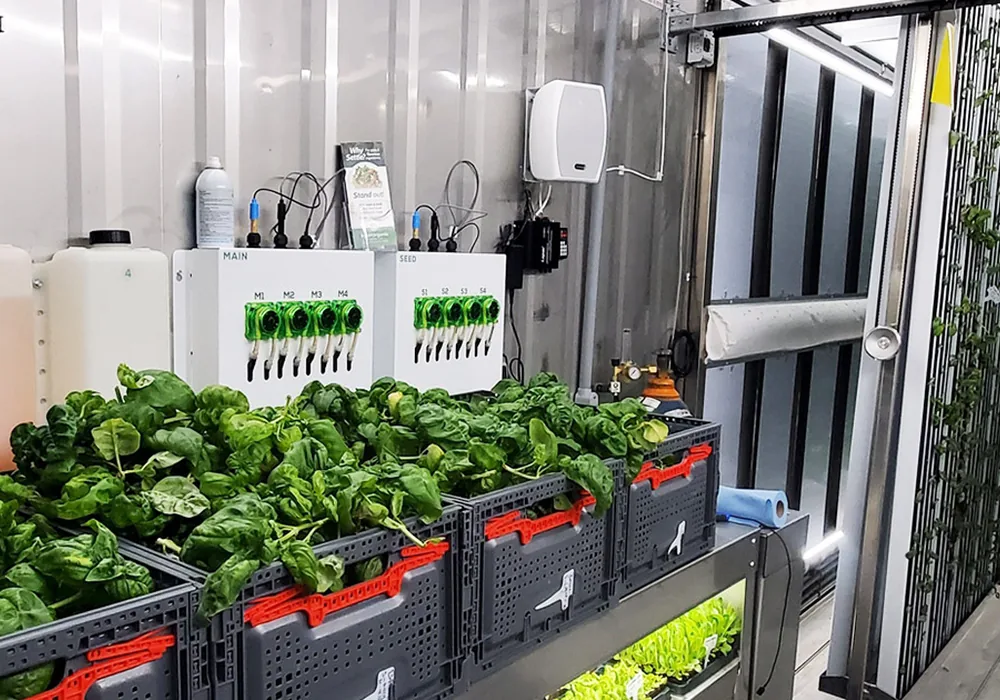
Inside a plant factory there is no soil to prepare and no weather to wait on. Crops grow on stacked racks in layers, under LED spectra selected for the crop, with nutrient solution and climate under automatic control. Temperature, humidity, carbon dioxide and nutrient parameters are adjusted by the system, and robots handle transplanting, inspection and internal transport. Day-to-day production needs a small number of technicians to watch the system and respond to exceptions. The heavy physical tasks that define field work are replaced by digital operations — a significant shift for an industry that struggles to attract young workers and is losing experienced growers.
Where the model earns its place
Controlled growing environments reduce pest exposure, but food-safety claims such as ready-to-eat still require separate controls and verification. Nutrient solution is recirculated; in systems of this kind, reported water use is about 5% of that of conventional soil cultivation. Production grows upward rather than outward, so the system does not need prime farmland: a purpose-built hall, a container or a building floor can all serve as growing space. Harvests continue through the year on a consistent schedule, which makes batch quality easier to hold and supply commitments easier to keep.
What it does not replace
The model has a clear cost structure. Structures, lighting and climate equipment require heavy upfront investment, and electricity is a running cost that decides viability. That makes plant factories a good fit for high-value crops — leafy greens, herbs, seedlings, berries — and a poor fit for staple grains at scale. Automation also has limits: equipment inspection, fault maintenance and variety trials still need skilled technicians, so "unmanned" in practice means fewer people, not none.
Its role is best understood as a complement to field agriculture. It suits urban food supply, remote sites, emergency or backup production and premium fresh produce. For bulk grain, open field and high-standard farmland remain the main productive base. The future is more likely to be coexistence — field, protected cultivation and plant factories each doing what it does best.
How to judge whether it fits a project
- Crop value per square meter, and how much of the harvest can be sold at a premium.
- Energy price and local climate, which together set the running cost.
- Distance to market and shelf-life requirements.
- Availability and cost of labor on the site — the case is strongest where labor is scarce and expensive.
- Access to technical staff for maintenance and crop management.
- A phased start: prove one module before the full capacity is built.
As LED efficiency improves and AI scheduling, storage and solar power become cheaper, more crops will cross the economic line. The most durable change plant factories bring to agriculture is not a particular machine but a method: production planned and adjusted on data rather than on experience and weather.